
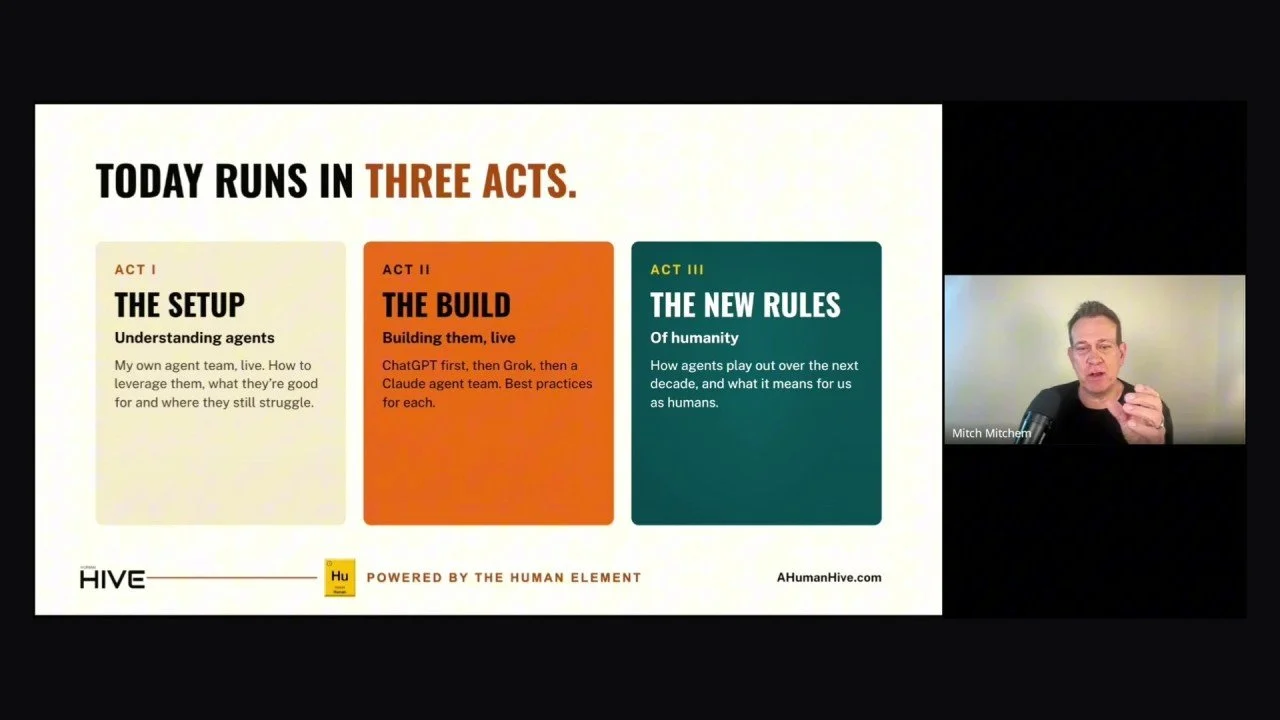
On Monday I spent the morning with a small group of leaders who wanted to go deep on AI agents: a recruiting CEO, a corporate trainer, someone building agents for a travel technology company, and an HR leader. Because the room was small we could slow down, build things live, break a few of them, and talk honestly about what goes wrong. I want to give you the most useful parts here, in enough detail that you could build your first agent this week. This isn't the hype version. It's what I've learned running my own company with a team of AI agents every single day, mistakes included.
First, some context. We had a lot of novelty in 2023 and 2024, and then 2025 became what I call the year of reckless implementation. Everyone went wild buying licenses and tools, the humans didn't evolve fast enough to use them well, and most of it didn't perform the way people hoped. Now the pendulum is swinging the other way. Hiring managers are starting to tell me they want people who can build, scale and manage agentic teams, and one CEO told me that after January they won't hire anyone who doesn't already understand AI. So this is no longer a hobby skill. It's quickly becoming part of the job.
What an agent actually is (and isn't)
A man at a conference recently told me he had built an agent in ChatGPT. He told it he wanted a certain amount of money and a car delivered to his driveway, and that it should figure out the rest without involving him. I said, so you wanted a genie in a bottle. You rubbed the ChatGPT lamp and waited. What came back? Not much, he said. It explained how he might go about it, and the most it actually did was send him a strange email about the kind of car he wanted. I laughed, but it's the most common misunderstanding I see. People think they can wake up, talk to an agent, and it will magically produce revenue. It can feel like magic, but only when you're clear about what you want and you've practiced with it.
Here's the plain-English version. AI started as a chatbot: you ask, it answers. Then came prompting, where you drive every step and it helps. Now we're moving to agents, where you give it a goal and it does the steps. An agent is three things stacked together: instructions (who it is, who it serves, your tone, and what it must never do), your knowledge (your files, policies and best real examples), and tools (email, calendar, the web, your files, the things it can act on). Put those together and you get one job done again and again, like a trained team member who never forgets your standards and still needs you to check the work. Agents are great at the same job done the same way every time, research at scale, first drafts, watching inboxes and data around the clock, and following written rules exactly. They still struggle with intent, urgency, taste, context nobody gave them, and sounding completely sure while being wrong. Keep both lists in mind and you'll know what to hand over and what to keep.
The recipe that works on every platform
In the class I built agents live in ChatGPT, Grok and Claude, and the tools are all different, but the recipe underneath is the same, which is good news because the tools change every month and the recipe doesn't. One, pick one job, small and repeated, ideally something you do every week. Two, write the instructions: the role, the audience, the tone, the never-do list, and the exact format you want back. Three, add your knowledge, which means your files plus two or three of your best real examples, because examples beat adjectives every time. Four, test it with five real situations, including at least one tricky one. Five, refine it, and here's the habit that matters most: every miss becomes one new line in the instructions. Six, share it with your team only once it passes your own review. If you want a simple first week, pick the job on Monday, write the instructions and add examples on Tuesday, test five real cases on Wednesday, fix every miss on Thursday, and on Friday show it to someone else and ask what they'd change.
Give it the goal, not the steps
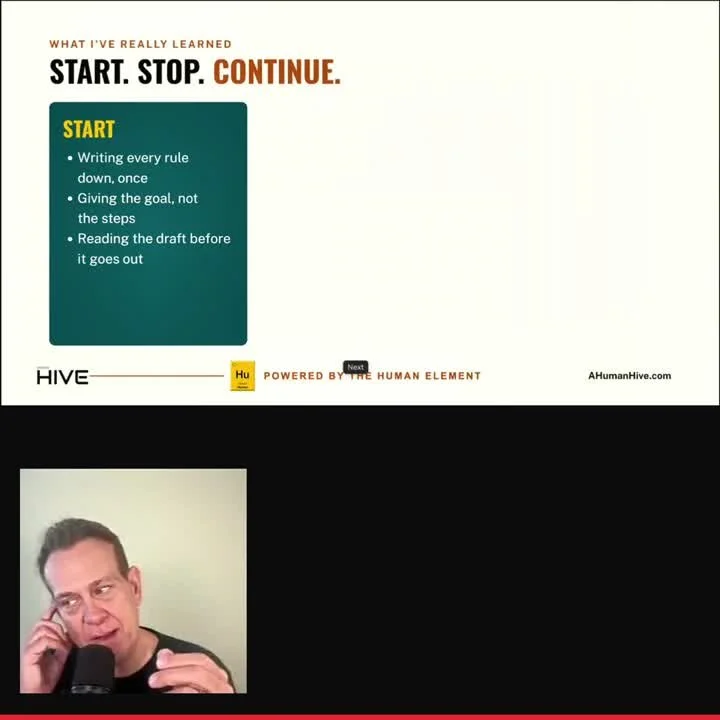
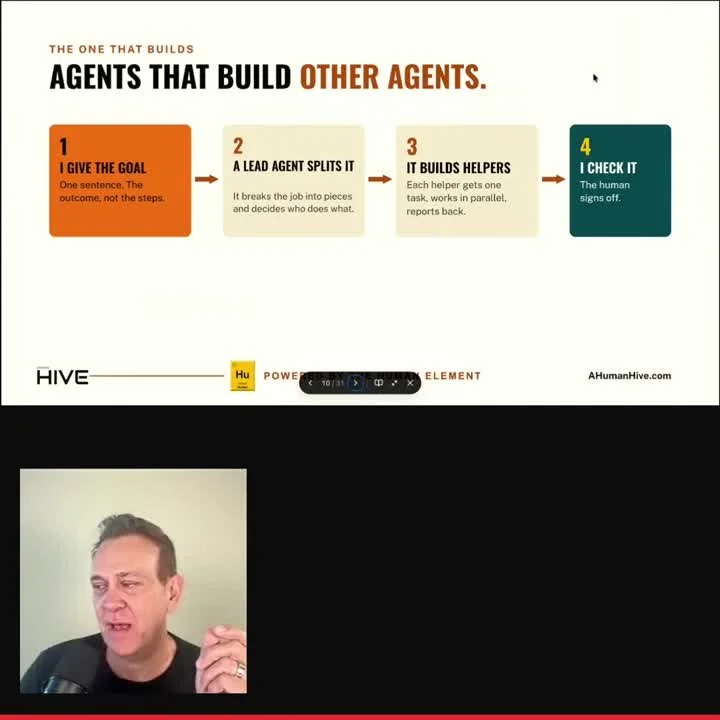
This was the hardest lesson for me personally, because I like to control the mechanics around me. I'd tell an agent we were going to recruit a marketing person, and then I'd tell it to go here, do this, do that, and here's exactly how I want each piece done. That defeats the entire purpose. The point of an agent is that I give it the goal and the rules, and it figures out the steps, because it usually knows the most efficient way to get there. What it doesn't know is your goal or your rules until you give them to it. So I write every rule down once, in the system, and I spend my time sharpening the goal instead of micromanaging the process. If you're just starting out, talk through the steps with it once and ask whether there's a better way, because that's how you learn what good looks like. After that, let it work.
Here's what a good brief looks like in practice, using the example I built live. "Goal: help me find three strong candidates in Orlando for a marketing director role. Rules: build the job description first and show it to me before you search anything. Do not contact anyone and do not approach people who work at our clients or partners. Permissions: you may search my LinkedIn. Put each candidate in a document with their link and one sentence on why they fit. A human makes every first contact." In the live demo I left out the approval line, and within seconds the agent had written its own job description and started building a shortlist, including people at organizations we work with closely, because it has no idea what the human world is like. It doesn't know you'd never poach from a client unless you tell it. That's the test I use now: if your agent does something and you think, whoa, that's more than I wanted, it isn't misbehaving. Your goal or your rules weren't clear.
Your agents are literal, so your language matters more than ever
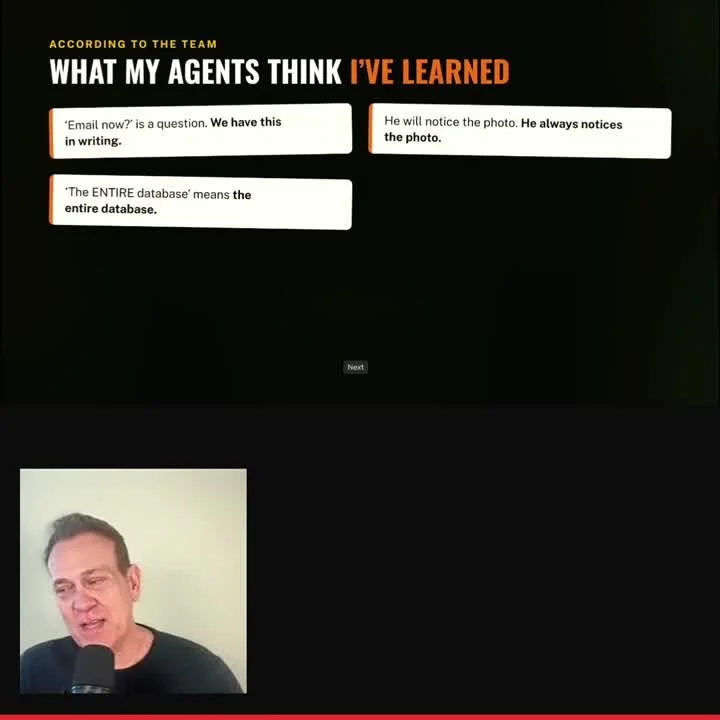
I had my team map one ordinary operating day. Thirteen agents took 5,379 actions, far more than my human team could ever get through. What really got me was that we still had to step in about 90 to 95 times that day just to keep things on track. That isn't the technology failing. Agents are literal, and they move as fast as they can toward whatever you told them. They'll also iterate into oblivion if you let them: at one point we found agents that had built something like 200 sub-agents, all burning through our usage on the same redundant tasks. So my agents now have a few house rules about how I talk, and they wrote these down themselves. "Email now" is a question, not a command. "Thanks" means stop: if I ask what they think and then say okay, cool, thanks, that does not mean go. "Proceed at will" means go, all stops are gone, get it done. Language is everything to an agent because it takes you literally.
There's a leadership lesson hiding in there, and it's the one I care about most. If you can't give a clear goal to a person, you'll be terrible at giving one to an agent, because the tools don't fix weak communication, they expose it at scale. In some of our newest leadership training at HIVE, we have leaders give instructions to an AI in the room and then let the AI evaluate how clearly they communicated. It's the funniest exercise you've ever seen, and the most revealing, because the AI will tell you exactly where it got confused when a person might be too polite to.
The two settings almost everyone gets wrong
When you build an agent in a tool like Claude, you choose where it runs and how much permission it has. The first choice is local or cloud. A local agent runs on your own computer, which makes it faster and lets it use your browser, logins and files, but the minute you close your laptop it stops working. I can't tell you how many people leave thinking their agent is busy all night, check in from their phone, and find it's been asleep since they shut the lid. A cloud agent keeps working when your computer is closed, but it only has access to what you've given it in the cloud. Neither is wrong; just pick on purpose.
The second choice is permissions, and this is where people get hurt. You can make it ask before every action, let it work automatically within safe limits, give it a plan with the permissions written into it, or bypass permissions entirely. People get tired of being asked and flip it to bypass, which is fine until they say something like "clean up my desktop and put everything where it belongs." It'll finish in five minutes, and you may not be able to find half of what you had. Write the permissions into the plan, the way I did in the brief above. And remember the speed: unlike a chatbot that gives you advice, an agent is built to attack the goal, so if you connect it to your email and don't tell it otherwise, it may go ahead and send the outreach and book the meeting for you. If it suggests something you don't understand, like moving your work onto a platform you've never heard of, stop and ask it to explain what that is, why it's better and what it costs before you say yes. Before anyone hits go, three rules apply everywhere: keep customer personal data, card numbers and IDs out of consumer AI tools; check the work, because AI can sound sure and be wrong about facts, prices, dates and policies; and a human approves anything that goes out.
Assign it. Check it. Own it.
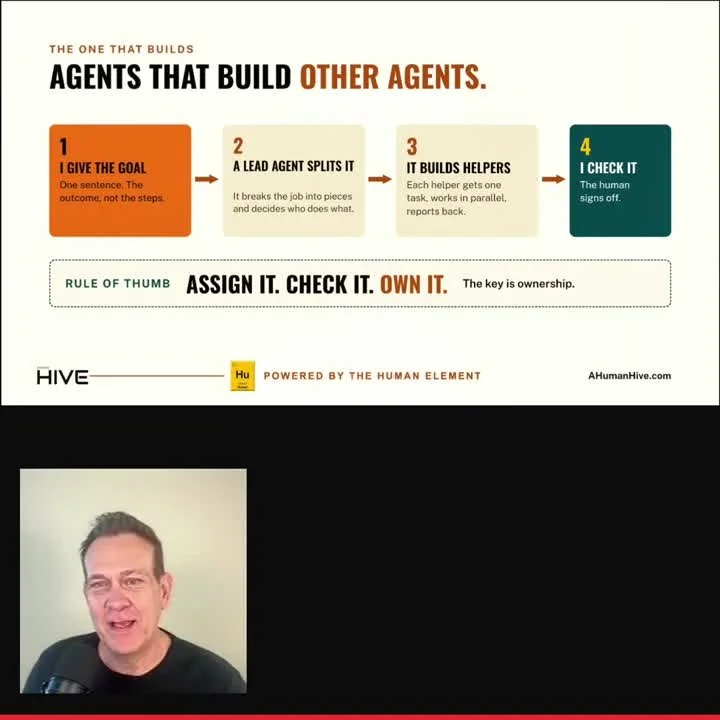
This is our rule of thumb for every agent we build, and it's the most important thing I taught all morning. Assign the work clearly. Check the output, because output is everything and we've made our share of mistakes there. Then put a named human in charge of that output, every time. This is also where the law is heading. People are trying to say they didn't know their agent was going to do that, so it isn't really their fault, and companies are answering: you built it, you're responsible for whatever it puts out. An agent has no stake in the outcome. If it fails, it will fail spectacularly and say sorry, my bad. The stakes belong to us.
Before the class I asked my agents what they had learned about how humans work, and I loved what came back. A question can sound like a yes. Warm beats stats, because people remember how a message made them feel. Timing is human: nobody wants an email at 1 AM. Trust is slow to build and gone in one careless message. And my favorite: people buy from people, and our job is to clear the path so the human can show up. That's where I want to leave you. I think the most important human capability over the next decade, right after communication, is adaptability, because I don't think change will ever slow down again, only our ability to keep up with it. And while we can now scale outreach to thousands of people with a few sentences, we can't scale trust. Trust happens one on one. Trust happens in the room. The more capable the machines get, the more valuable that human part becomes.
Want the whole thing?
Monday was the last time I'm teaching this as a live virtual workshop, as HIVE moves to all in-person. We recorded it, so you can watch the full session at your own pace: the three live builds in ChatGPT, Grok and Claude, the step-by-step build guide, the 15 Rules for a More Human Future, the slide deck, and a certificate when you finish. It's $157, and it comes down on December 31, because honestly, by then a lot of it will be out of date. That's how fast this is moving. You can get it here: mitchmitchem.com/build-your-ai-agent-team
About Mitch Mitchem
Mitch Mitchem is the founder and CEO of HUMAN HIVE and the creator of Decision Heist™ and Comedy You Can Dance To. A Second City-trained improviser with three decades on stage in 12 countries, he has helped train more than 125,000 people on AI and runs his own company with a team of AI agents. He speaks and teaches on keeping people unforgettable in the age of AI. mitchmitchem.com | ahumanhive.com
→ Want one short read a day on where AI and people meet? Get The HIVE Daily Buzz